For everyday commuters, fitness enthusiasts, and casual cyclists alike, understanding road hazards is essential to staying safe. While many riders naturally worry about heavy traffic or poor weather, national crash data reveals another critical factor: time. When you choose to ride plays a massive role in your overall risk profile on the road.
By examining national collision statistics, traffic safety reports, and multi-year crash trends, patterns emerge regarding when bicycle accidents occur most frequently—and when they are most severe. Recognizing these high-risk windows allows cyclists to adjust their habits, enhance their visibility, and take proactive measures to mitigate danger.
Peak Crash Hours: The Evening Commute Hazard

According to comprehensive data compiled by the National Highway Traffic Safety Administration (NHTSA), bicycle fatalities and severe collisions are not evenly distributed throughout the day. While many assume that the morning rush hour poses the greatest threat due to heavy traffic volume, national statistics consistently show that the late afternoon and evening hours are significantly more dangerous.
The peak window for cyclist fatalities occurs between 6:00 PM and 9:00 PM, followed closely by the 3:00 PM to 6:00 PM block. Several overlapping factors contribute to this sharp spike in risk:
- Driver Fatigue and Distraction: At the end of the workday, drivers are often fatigued, impatient, or mentally distracted, leading to delayed reaction times and reduced awareness of vulnerable road users.
- Changing Light Conditions: The evening rush hour frequently coincides with twilight and dusk. During these transitional light periods, driver vision declines rapidly, making small profiles like bicycles much harder to detect.
- Increased Traffic Complexity: Evening traffic typically involves a mix of commuting vehicles, delivery trucks, pedestrians, and cyclists all competing for road space under declining light conditions.
In contrast, the morning commute (between 6:00 AM and 9:00 AM) accounts for a substantially lower percentage of fatal crashes, despite high traffic volumes. Morning drivers generally benefit from daylight, predictable traffic flow, and better overall alertness compared to evening commuters.
Day of the Week Dynamics: Weekdays vs. Weekends
Crash trends also vary noticeably depending on the day of the week. Analyzing weekday versus weekend statistics provides vital context on how road user behavior shifts throughout the week.
During weekdays, collisions cluster tightly around the afternoon and evening commute hours. These incidents predominantly involve urban commuters navigating city streets, commercial corridors, and high-density transit zones. Traffic volume during these periods creates frequent conflict points at intersections and turned vehicle crossings.
Weekends present a distinctly different risk profile:
- Shift in Peak Risk Hours: On Saturday and Sunday, dangerous periods shift further into the late night and early morning hours (between 9:00 PM and 3:00 AM).
- Impaired Driving Factors: Weekend night hours see a dramatic rise in alcohol- and drug-impaired drivers on the road, increasing the probability of high-speed or rear-end collisions.
- Recreational Riding Patterns: Weekend cyclists often ride longer distances, use unfamiliar routes, or travel on higher-speed rural roads where shoulder space may be minimal and help is further away.
Seasonal Variations and Daylight Shifts
Seasonality plays a substantial role in bicycle accident rates. Across most regions, bicycle activity peaks during the warmer months of summer and early autumn. Consequently, the total volume of reported bicycle crashes is highest between June and September.
However, total crash volume does not tell the whole story. The risk per ride increases significantly during late autumn and winter due to several environmental shifts:
Shorter Daylight Hours: The transition out of Daylight Saving Time leads to sudden darkness during the afternoon rush hour. Drivers who were accustomed to clear daylight during their 5:00 PM commute are suddenly navigating dark streets, leading to an immediate seasonal uptick in pedestrian and cyclist collisions.
Inclement Weather and Reduced Traction: Autumn leaves, rain, ice, and winter road debris compromise traction for two-wheeled vehicles while simultaneously increasing stopping distances for motor vehicles.
Lower Driver Expectation: Because fewer cyclists ride during colder months, drivers drop their general awareness, making them less likely to scan bike lanes or check blind spots before turning.
Key Factors Amplifying Time-Based Risks
Time-based risk is rarely a single isolated variable. Instead, the most dangerous times to ride represent a convergence of environmental, behavioral, and structural factors that multiply the odds of a severe incident.
1. Vision and Lighting Disparities
Human eyes struggle during twilight—the period just after sunset when ambient light drops but streetlights have not yet reached full visual impact. Drivers rely heavily on contrast to spot objects. Without active lights, a cyclist wearing non-reflective clothing blends into dark backgrounds, asphalt, or surrounding vehicle shadows.
2. Speed and Road Classification
High-risk hours become exponentially more dangerous on arterial roads and non-interstate highways where speed limits exceed 35 MPH. National crash statistics indicate that the vast majority of cyclist fatalities occur on non-intersection road segments in urban areas during low-light conditions, where higher vehicle speeds leave zero margin for error.
3. Intersection Conflicts
Intersections remain the primary site for non-fatal, high-impact bicycle accidents. During evening rush hours, “right-hook” turns (where a vehicle turns right across a straight-moving cyclist’s path) and “left-turn failures” (where a oncoming driver turns across a cyclist’s path) spike dramatically as drivers rush through yellow lights or fail to check adjacent bike paths.
Actionable Safety Strategies for High-Risk Hours
While you cannot control driver behavior or seasonal light shifts, you can take concrete, evidence-based steps to lower your risk profile when riding during high-danger periods:
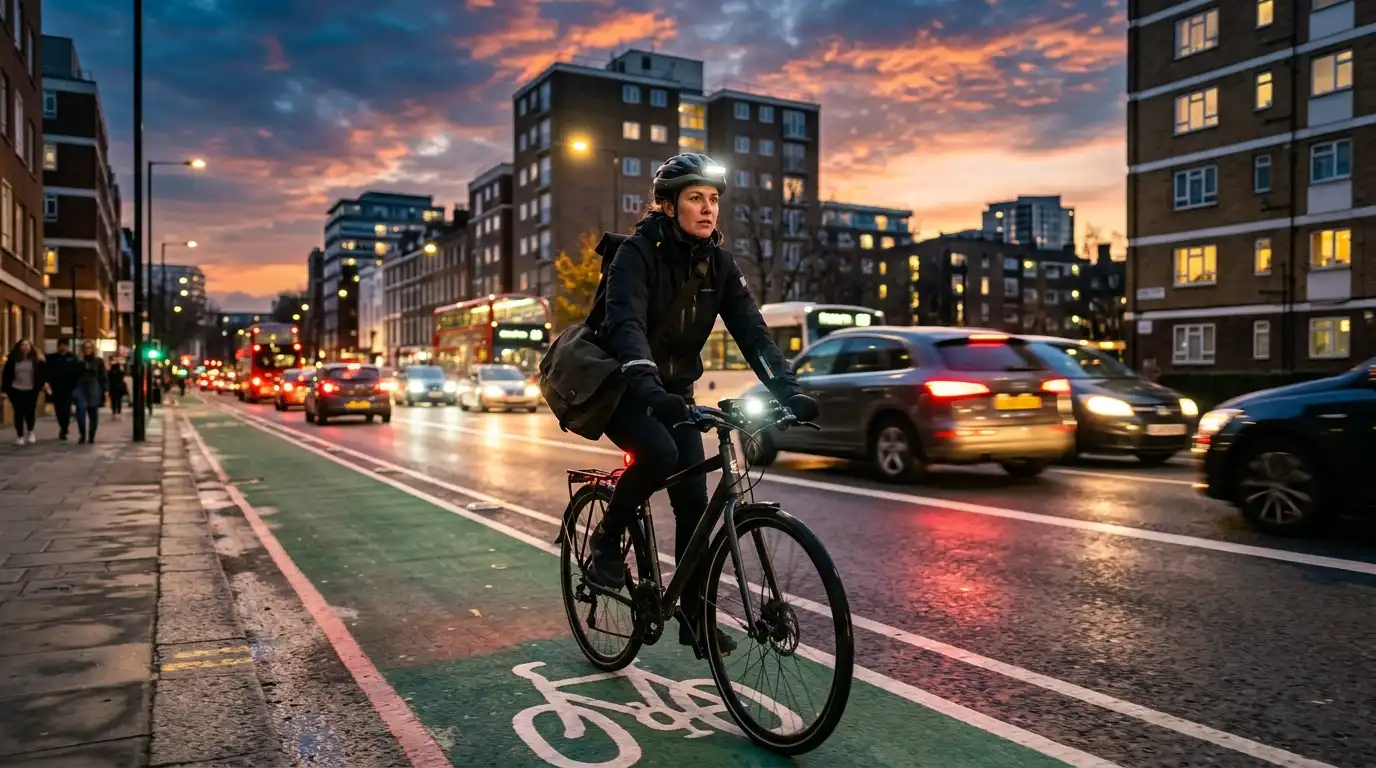
- Utilize Active Lighting Year-Round: Relying solely on passive reflectors is insufficient. Run a steady or pulsing white headlight (at least 300 to 500 lumens for city riding) and a high-output red taillight, even during daytime hours, to significantly boost your visual contrast.
- Enhance Biomotion Reflectivity: Research shows that placing reflective materials on moving parts (such as ankles, pedals, or knees) helps drivers recognize you as a human cyclist much faster than static reflective vests alone.
- Choose Defensive Routing: During dusk and evening commute windows, opt for quiet side streets, dedicated off-street bike paths, or well-lit secondary roads rather than high-speed arterial corridors.
- Assume Invisibility at Intersections: Approach all intersections, driveways, and commercial turns assuming drivers do not see you. Maintain a cover position on your brakes and prepare to yield even if you have the legal right-of-way.
By combining data-driven awareness with proactive riding strategies, cyclists can confidently navigate the roads while minimizing their exposure to the most critical danger windows identified by national crash research.